Golf Scorecard Paper: The Four Stocks We Print On
We print golf scorecards on four stocks. Standard is 80lb uncoated cover, matte and the easiest to mark with a pencil. Premium is 10pt or 12pt cover coated on one side, gloss outside and uncoated inside for scoring. Linen is an embossed uncoated sheet, sourced per order. Prices run from $0.36 to $0.96 per card, before size and finishing, on runs of 250 cards or more.
Every quote we send names one of four sheets. This guide is the whole list: what each one is made of, what it feels like in the hand, what a player can write on it, what it costs, and the coatings you can add on top. Every sheet but linen is one the press runs every week. Linen is sourced per order, and the linen section says what that changes.
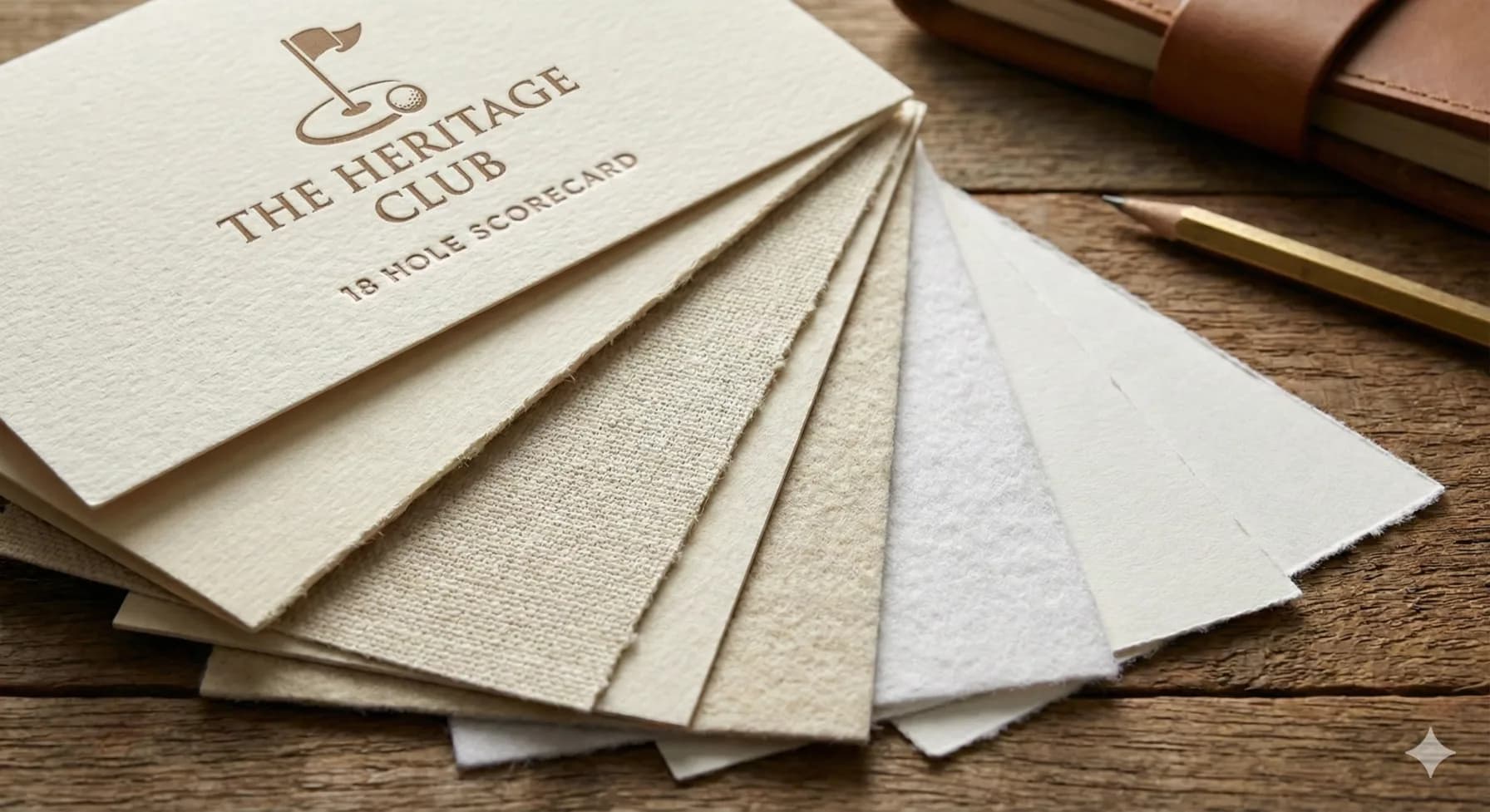
The four stocks, side by side
A scorecard has two jobs that pull against each other. The outside has to carry your artwork and look like it belongs to your course. The inside has to take a pencil, in a cart, on a damp morning, and still be legible at the turn. Every stock we offer is a different answer to that pull, and the table is the short version of the rest of this page.
| Stock | Build | Writes with | Per card, 250 to volume |
|---|---|---|---|
| Standard (80lb Cover) | Uncoated on both faces, natural matte surface | Pencil and ballpoint on either face | $0.60 to $0.36 |
| Premium (100lb Cover) | Gloss coating on one face, uncoated on the other | Pencil and ballpoint on the uncoated scoring face | $0.68 to $0.42 |
| Premium (12pt C1S) | Gloss coating on one face, uncoated on the other | Pencil and ballpoint on the uncoated scoring face | $0.68 to $0.42 |
| Premium (Linen) | Uncoated on both faces, an embossed linen crosshatch | Pencil and ballpoint on either face | $0.96 to $0.58 |
Prices are per card for full-color printing, before size, finishing, and shipping. The full tier ladder for each stock is on our pricing page, and the calculator there prices any combination on the spot.
Standard (80lb Cover): the everyday card
Uncoated matte finish, easy to write on with pencil or pen. uncoated on both faces, natural matte surface, 80lb cover, about 216 gsm.
It is the standard scorecard stock in the trade, and for good reason. It has enough body to hold flat on a cart clip and to fold once down the middle without cracking at the crease, and its surface has tooth: a golf pencil bites cleanly, a ballpoint dries on contact, and neither smears when a thumb drags across the grid. Ink sinks slightly into the fibers, so printed color sits a touch softer than on a coated sheet. On a card that is mostly grid and type, that reads as warmth rather than a loss.
- Choose it for: The everyday card. Dry-climate courses, cart play, high-volume daily rounds, and any card a player marks with a pencil.
- Price: $0.60 per card at 250 cards, down to $0.36 at the top volume tier. It is the base every other price on this page is measured from.
- Where it gives up: water. Uncoated paper absorbs what lands on it, so a card left on a wet cart seat comes back soft. For heavy dew or regular showers the answer is a coated stock or a coating pass, both covered below.
The coated-one-side premiums
Two of our four stocks are the same idea at two thicknesses: a cover sheet with a gloss coating on one face and nothing on the other. The trade calls it C1S, coated one side. The coated face takes the artwork, where the coating seals the surface so ink sits on top instead of soaking in: crisper edges, deeper color, a photograph that looks like a photograph. The uncoated face takes the scoring grid, where it behaves exactly like the 80lb sheet under a pencil.
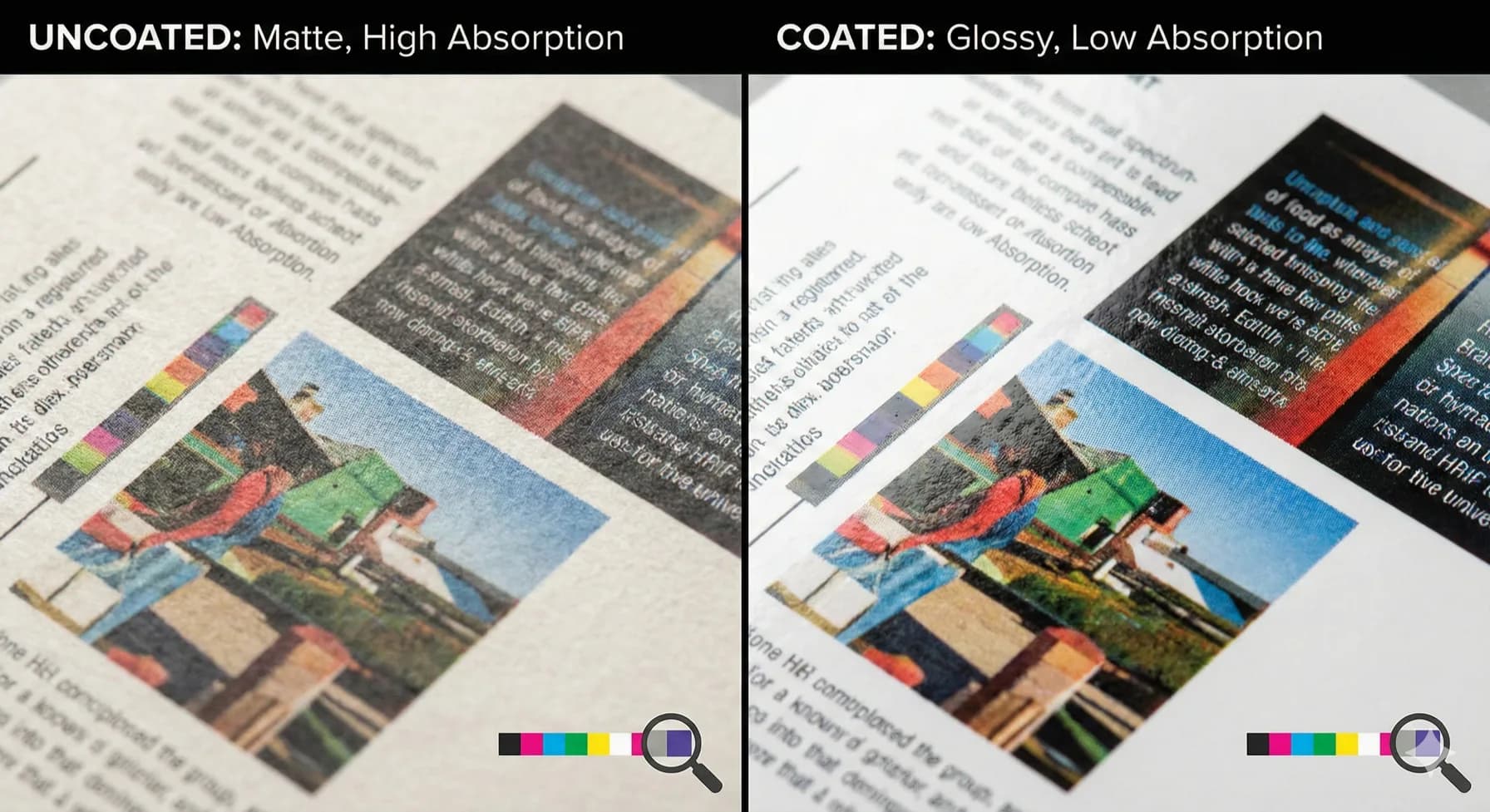
Premium (100lb Cover)
Gloss on one side, uncoated on the other, richer color, still writable. 10pt caliper, quoted as 100lb cover, about 270 gsm.
- Choose it for: Artwork that wants to look sharp: photography, a crest with fine detail, a sponsor panel. Stiffer in the hand than the 80lb.
- Price: $0.68 per card at 250 cards, down to $0.42 at volume, $0.06 to $0.08 per card, depending on quantity over the 80lb sheet.
Premium (12pt C1S)
Gloss on one side, uncoated on the other, our thickest, most durable stock. 12pt caliper, about 300 gsm.
- Choose it for: The card that has to survive a wet morning and a back pocket and still look like something a member keeps. Member-guest and championship cards.
- Price: $0.68 per card at 250 cards, down to $0.42 at volume, $0.06 to $0.08 per card, depending on quantity over the 80lb sheet.
The two coated stocks share one price ladder, $0.06 to $0.08 per card, depending on quantity over the standard sheet. Between them you are choosing thickness, not paying for it: 12pt is noticeably stiffer in the hand and is the one to pick when the card is going home in a back pocket.
One thing worth knowing before the proof: the gloss face is not a writing surface. Pencil skates on it and ballpoint takes a moment to dry. We lay cards out so the grid lands on the uncoated face, which is the whole point of a C1S sheet, but if your design puts a signature line or a notes box on the artwork side, say so and we will talk through it at proof stage.
Premium (Linen): sourced per order
Uncoated with an embossed linen crosshatch, writable with pencil or pen, sourced per order. Uncoated on both faces, an embossed linen crosshatch. Weight confirmed at proof, since the sheet is sourced per order.
Linen is what a card looks like when the surface is part of the impression: a subtle crosshatch embossed into the paper, the feel of good stationery. It is uncoated on both faces, so it takes a pencil the way the 80lb sheet does and gives up water the same way. Texture also softens fine print, which is why the advice below is to set the grid type a little larger.
- Choose it for: Club and resort cards where the surface is part of the impression, a card that feels like good stationery. Choose larger grid type, because texture softens fine print.
- Price: $0.96 per card at 250 cards, down to $0.58 at volume, about 60% over the 80lb sheet at every tier ($0.22 to $0.36 per card, depending on quantity).
- Setup: a flat $35 paper setup per order, listed as its own line in the calculator.
- Availability: unlike the stocks above, linen is sourced per order rather than run every week. We confirm the sheet and its weight at proof, before anything goes to press.
Reading the numbers: lb, pt, and gsm
Paper is quoted three ways, and a scorecard quote can use all three in one line. None of them is hard once you know what each measures.
- Pounds (lb): the weight of 500 sheets at the trade's base size for that grade. Cover stock and text stock have different base sizes, so 80lb cover is a far heavier sheet than 80lb text. Every stock here except linen is cover.
- Points (pt): thickness, in thousandths of an inch. 10pt is 0.010 inches, 12pt is 0.012. This is the number to trust when you are comparing how stiff two sheets will feel, because coating adds thickness without adding much weight.
- Grams per square meter (gsm): the metric weight, and the only one that compares cleanly across grades. Our stocks run from roughly 216 gsm for the 80lb cover to about 300 gsm for the 12pt. Ordinary copy paper is about 75 gsm, for scale.
If a quote from another printer names a stock this page does not, ask for its caliper in points and its coating. Those two facts put it beside one of our four sheets more reliably than the pound weight does.
Coatings you can add to any stock
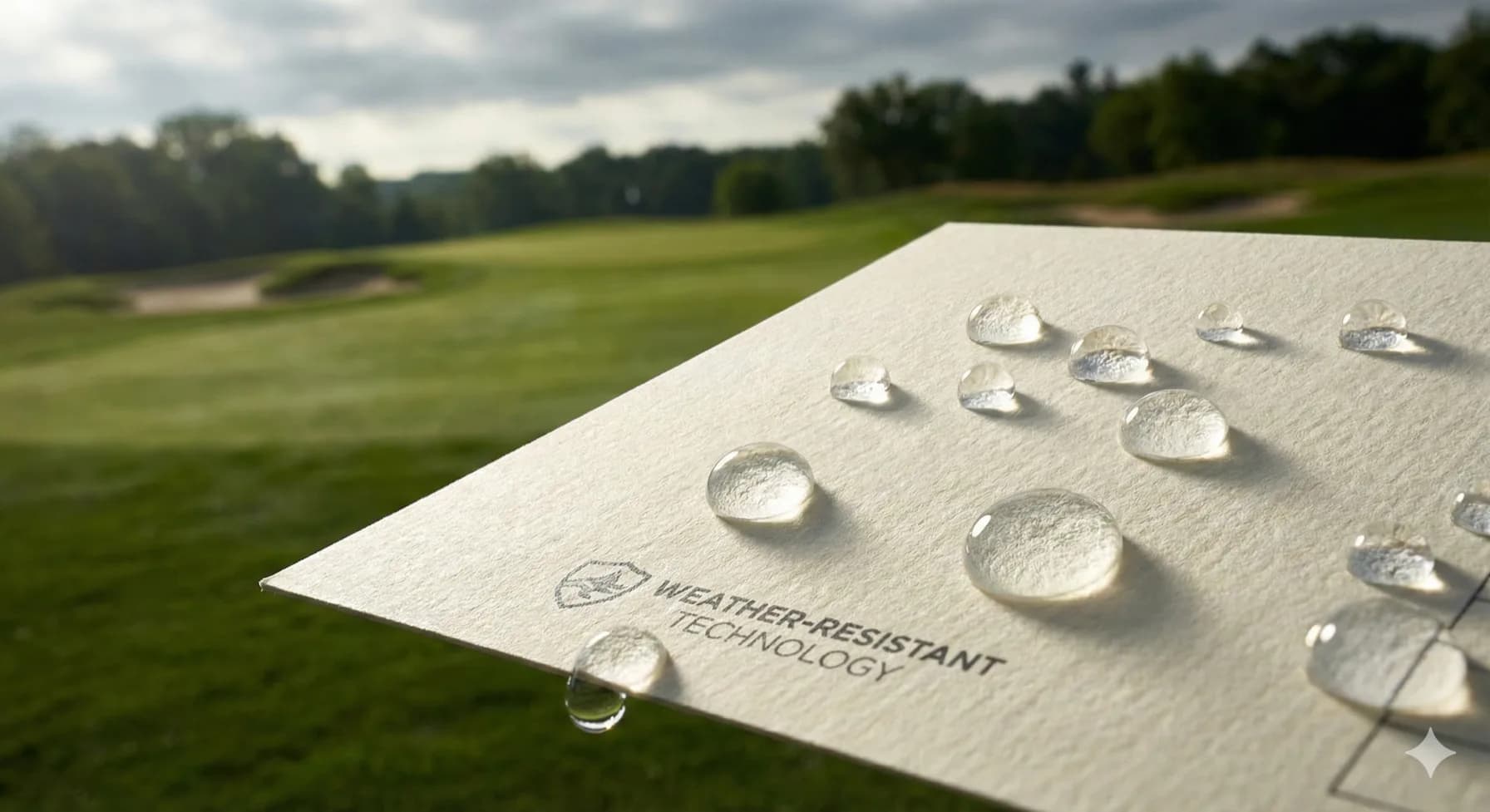
A coating is a finishing pass over the printed sheet, not a different paper. It goes on the artwork face, leaves the scoring face alone, and is the most cost-effective way to get water resistance without changing the stock underneath. Pick one per card.
| Coating | What it does | Adds per card |
|---|---|---|
| Aqueous Coating | Protective aqueous coating for added durability | $0.17 |
| UV Coating (1-Side) | Gloss or matte UV coating on one side for a premium finish | $0.25 |
| Lamination (1-Side) | Film laminate on one side for maximum durability | $0.25 |
- UV coating is cured under ultraviolet light into a hard, high-gloss skin. It is the one that makes a dark green or a photograph look deepest, and it resists scuffing in a cart holder.
- Aqueous coating is a water-based seal with a softer sheen. Less gloss than UV, less cost, and enough to shed dew.
- Lamination bonds a clear film to the face. It is the most water-resistant of the three and the stiffest, which is why it suits a card that will be handled hard for a full day.
All three go on the artwork face only. That is deliberate: a coated scoring grid is a grid nobody can write on.
What is not on the price list
A guide to what we price should be equally clear about what the calculator does not carry, so nobody builds a quote around a line that is not there.
- Synthetic waterproof sheets. Fully waterproof plastic sheets exist, and they are the right material for a yardage book that spends a season in a pocket; our premium books print on one. They are not one of the four scorecard stocks priced online, because a card lives for one round and a coated stock with a coating pass covers a wet one at a fraction of the cost. If your course needs more than that, say so with your quote request and we will talk it through as a one-off rather than a line on the calculator.
- Text-weight and bond paper. Anything lighter than cover stock folds soft and tears at the crease. We do not quote scorecards on it.
- Weights between the three. The calculator carries no 65lb or 100lb uncoated option and no coated-two-sides sheet. Four stocks is the whole online list, and keeping it short is what keeps the reorder identical to the last run.
Yardage-book stock is a different question
A scorecard and a yardage book ask opposite things of paper. The card is written on once and thrown away at the 19th hole. The book is written in for a season and lives in a back pocket through rain, sweat, and a hundred openings. So the book's cover and pages are chosen for endurance, and the premium edition moves onto a synthetic waterproof stock that no scorecard on the calculator uses.
- Standard books print on paper stock, from $4.50 per book, with an uncoated interior so the player can write.
- Premium books move to synthetic waterproof stock, from $6.50 per book, with green detail diagrams and a notes section.
Binding, trim, and the course data a book needs are on the yardage book specs page.
Which stock for your course
Three questions decide it, and you already know the answers.
- How wet is a typical round? Dry climate and cart play: 80lb uncoated. Morning dew most days: 80lb with an aqueous coating, or 10pt C1S. Regular rain, coastal air, or a card that rides a cart seat: 12pt C1S with UV or lamination.
- What is on the outside? A crest, type, and a scoring grid look right on any of the three. Photography, a rendered course map, or a sponsor panel with fine logos want a coated face.
- Does the card go home? A daily-play card is used and binned, and the 80lb sheet is the value choice at every quantity. A member-guest or championship card gets kept, and 12pt with a coating is the one that still looks right in a frame.
The layout supports two stocks on one artwork: the standard sheet for daily play and a coated stock for tournaments. Only the stock line on the quote changes.
If you would rather decide by following a round than by reading a table, the best paper for golf scorecards, round by round walks one card from the first tee to the 19th hole and names the moment each sheet is for.
Feel them before you order
Stock is the one choice on the spec sheet that changes how the card feels more than anything else, and it is far easier to decide with the sheets in your hand than from a description. Samples are available on request: ask on our contact page, and try a golf pencil on each sheet when they arrive. Samples are billed before they ship, and we confirm the charge first.
Golf scorecard paper questions
What paper are golf scorecards printed on?
We print scorecards on four stocks: 80lb uncoated cover, the everyday sheet that takes a pencil on both faces; two coated-one-side cover stocks, 10pt and 12pt, with gloss on the artwork face and an uncoated scoring face; and a linen-textured uncoated sheet, sourced per order. The uncoated sheet starts at $0.60 per card at 250 cards and falls to $0.36 at volume; the coated stocks add $0.06 to $0.08 per card, depending on quantity, and linen runs about 60% above the 80lb sheet plus a $35 paper setup.
Is 80lb cover stock thick enough for a golf scorecard?
Yes. 80lb cover is about 216 gsm, roughly three times the weight of copy paper, stiff enough to hold flat on a cart clip and to fold once without cracking. It is the standard daily-play sheet. If the card has to shrug off dew or a shower, step up to a coated stock or add a coating rather than a heavier uncoated sheet.
What does C1S mean on a scorecard quote?
Coated one side. The sheet has a gloss coating on one face, where the artwork prints richer and sharper, and is left uncoated on the other, where players write. 10pt and 12pt are the sheet's thickness in thousandths of an inch, so 12pt C1S is the thicker of the two.
Can golf scorecards be waterproof?
Water-resistant, yes, on the coated stocks priced online; fully waterproof is a conversation. The uncoated stocks, linen included, absorb water like any paper. A coated-one-side sheet with a UV, aqueous, or laminate pass on the artwork face sheds dew and light rain, and the uncoated scoring face still takes a pencil. Synthetic waterproof stock is what our premium yardage books are printed on, from $6.50 per book. A synthetic scorecard is not on the calculator, so ask for it with your quote request and we will price it as a one-off.
Which scorecard stock is easiest to write on with a pencil?
80lb uncoated cover. Its matte surface has enough tooth for a golf pencil to bite cleanly and for ballpoint to dry on contact, on both faces. The coated stocks write just as well on their uncoated scoring face; the gloss face is for artwork, and a pencil will skate on it.